

A Short History of AI in FME
From Automation To Intelligence: The Rise Of AI Across The FME Platform
Article written by Ian Fletcher, FME Expert at 1Spatial
Keeping track of all the ways in which AI services are integrating with our professional tools can feel daunting: new agents, natural language models and AI-assisted tools are rapidly appearing in the applications that we use daily. Safe Software’s FME platform has a proud record of keeping pace with the latest innovations in data integration and it is no surprise that we have seen the introduction of a number of AI tools into aspects of both Form and Flow, designed to enrich the workflows, web applications and automations that we can create. Several key innovations have appeared in recent versions of FME Form and Flow, and it is therefore useful to step back and review how these have evolved over the past few years.

AI Assist
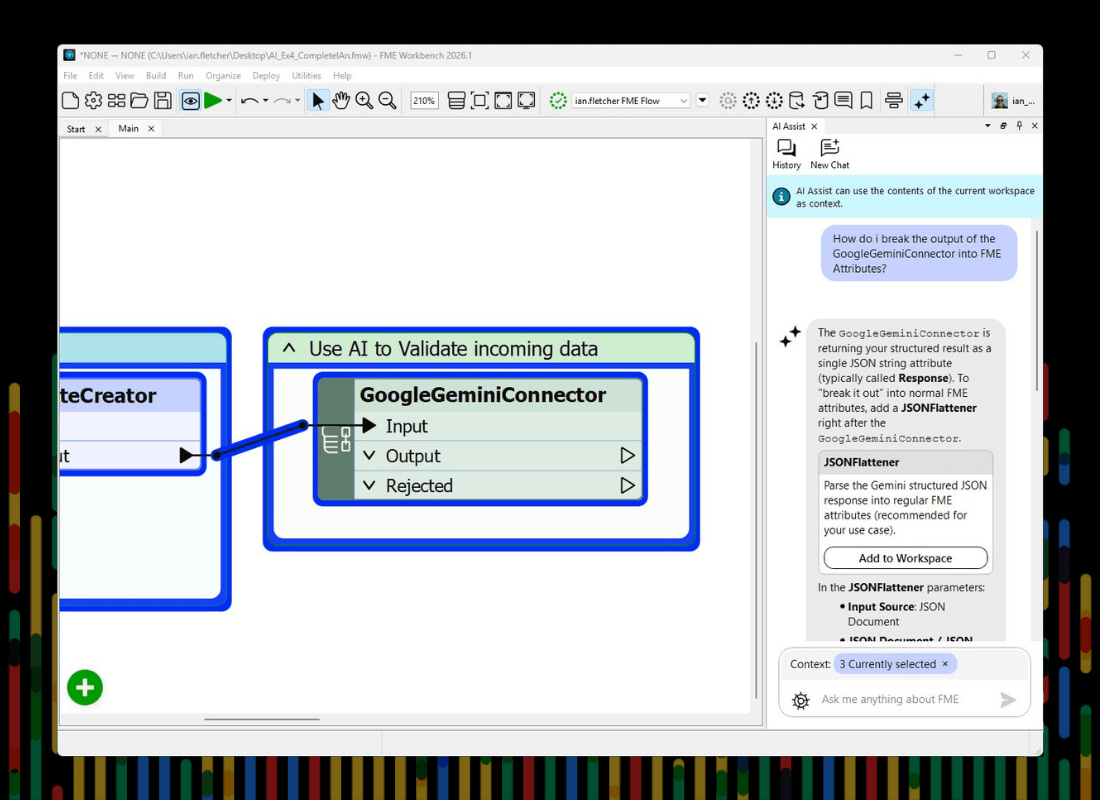
AI Assist was first introduced in FME Form 2023.2 as an embedded tool, helping users generate, refine and describe Regex, SQL, and Python snippets within transformers such as PythonCaller, StringSearcher, and SQLExecutor. With the introduction of enhancements in FME Form 2025.1, it has evolved into a far more flexible assistant integrated directly into the main workspace interface. Users can now interact with AI Assist conversationally to troubleshoot issues, generate workflow ideas, or understand unfamiliar logic within an existing workspace.
Figure 1: Using AI Assist to generate workspace suggestions
AI Connectors
The “Any Data, Any AI” principle, deeply embedded into all aspects of the FME platform, is perhaps most evident in FME’s expanding ecosystem of AI connectors and transformers. There are now nearly 40 official Safe and community made AI-related transformers available from the FME Hub, enabling integration with a wide range of platforms and services. These connectors allow users to embed AI enhanced tasks, such as classification, summarisation, and content generation, directly into FME workflows in a controlled and secure way, whilst also allowing you to manage the outputs accordingly.
The ecosystem continues to grow, with recent additions such as the AzureAIFoundryConnector alongside ongoing enhancements to the Azure AI Services package amongst others. These updates enable structured outputs for tasks like text and image classification, as well as AI-generated content, all delivered in formats that seamlessly integrate with downstream FME processing.
Data Virtualisation
Introduced in FME 2025.1, Data Virtualization represents a significant step forward on the path towards AI-ready data access. Data Virtualisation allows users to configure secure, OpenAPI-compliant endpoints directly from FME Flow, effectively turning FME Form workflows into managed API endpoints without the need for additional investment in a standalone API-hosting platform. Whilst not leveraging AI tools directly, a Data Virtualisation layer on top of your data has two advantages worth considering; Not only can you provide access to your data from any application which can communicate over a network using an API, but furthermore, AI Agents can then be given secure and limited access to your data, via these endpoints, enabling controlled, auditable interaction with your enterprise data using natural language prompts.
MCP Server Tools
With FME 2026.1, the introduction of the MCPCaller transformer marks a shift towards more dynamic, agent-driven workflows. Instead of interacting with a single predefined process, FME Form workflows can now call on a library of traditional and AI-enhanced tools, where the MCP host itself decides which tool is most appropriate for the task in hand. This enables more flexible and adaptive behaviour within integrations which can respond appropriately to different incoming requests. Looking ahead, we anticipate the FME 2026.2 release to bring MCP server-hosting capabilities directly into FME Flow, allowing organisations to expose their own tools and workflows to an MCP Server without relying on external hosting solutions. This would enable fully self-contained orchestration of AI-driven processes within the familiar FME environment, further reinforcing its role as a central integration layer for both data and AI services.
Read the Safe Software Press Release here
Why It Matters
A lot has changed in FME over the past few years as the platform has responded swiftly to the changing data landscape we find ourselves in. As ever, you have the flexibility to use as much or indeed as little AI as you wish, depending on the requirements of your organisation and your own personal preferences.
Building AI into your workflows using the ever-expanding library of FME Form transformers gives you complete control over the services you use and allows one service to easily be swapped for another with minimal effort. With FME 2026.2 just around the corner, MCP hosting introduces a whole new tool in your armoury, and we expect more announcements in the months to come that will build on this.
As usual, MCP Hosting in FME Flow, alongside all future developments will be available from day one at no additional cost to clients allowing you to leverage these tools on day one without any further additional investment in time or resources.
Talk to our FME Experts
If you have any further questions on upgrading your FME infrastructure to take advantage of these tools, please be in touch with the FME team here at 1Spatial!
Contact Us